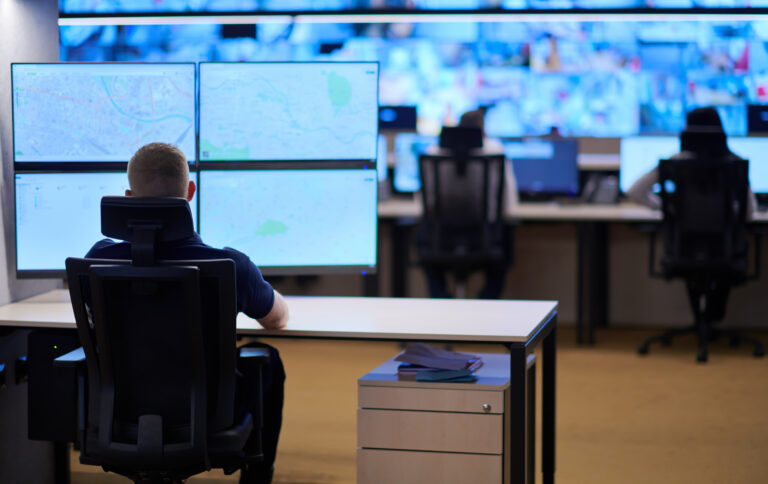
More security data does not automatically create better situational awareness. The real advantage comes from turning scattered signals into a clear, decision-ready picture.
A door-forced alarm appears at one site. A nearby camera shows movement. An access-control record shows a valid credential was used minutes earlier. A maintenance note says the door has been sticking all week.
The Security Operations Center (SOC) has the facts, but they are scattered. The operator must switch screens, reconcile timestamps, confirm the location, check site history, and decide whether the event is routine or developing into something more serious.
The data is available. The meaning is not.
That is the visibility gap: the distance between receiving security data and understanding what deserves attention, why it matters, and what action should happen next.
More Data Does Not Automatically Create Visibility
Modern physical security operations pull information from intrusion systems, video, access control, intercoms, environmental sensors, analytics, visitor systems, and other sources. Each system can add useful information. But adding more inputs only improves awareness when the SOC can connect those inputs to an operational decision.
True visibility is not the ability to display every event. It is the ability to create a timely, trustworthy, decision-ready picture. For an operator, that picture should answer a small set of questions quickly: What happened? Where? Who or what is involved? What related activity matters? How serious is it? What action is required now?
The industry is already moving toward more connected environments. Genetec’s 2026 State of Physical Security report found that more than 70% of respondents were using unified or integrated systems. Yet integration by itself does not guarantee operational visibility. Data can move between systems and still reach an operator without enough context, priority, or response guidance to support a confident decision.
The Gap Usually Opens Between Systems
Most security platforms are designed to do their own jobs well. The camera records video. The access-control system logs credential activity. The intrusion panel reports alarms. The problem appears in the handoffs between them.
When nothing correlates those inputs into a single incident view, the operator becomes the integration layer. They hold the pattern in their head, move between windows, reconstruct a timeline manually, and search for the information that explains what the raw signal means.
Events arrive separately
A motion event, a denied entry, and an intrusion alarm may describe one developing situation. If they reach the operator as three unrelated notifications, the SOC sees activity but not the incident.
Context lives somewhere else
Location labels, recent event history, service notes, schedules, contact details, site status, and standing instructions may be stored in different places. Every additional search adds friction at the moment clarity matters most.
Everything competes at the same level
Routine activity, nuisance alarms, maintenance conditions, analytics, and high-consequence events can all enter the same queue. Without risk-based prioritization, operators spend more effort sorting activity and less effort assessing what requires action.
Response guidance is disconnected
An operator may understand the alarm but still need to locate a procedure, escalation rule, contact list, or site-specific instruction. That separation slows response and makes outcomes more dependent on individual experience.
A useful test: If an operator must search several systems to determine what an event means, the organization may have plenty of data without having full operational visibility.
Why Blind Spots Persist in a Data-Rich SOC
The visibility problem is partly technical, but it is also operational. Security environments are often built over time around different sites, contracts, risks, budgets, and technology generations. Each addition may make sense on its own. Fragmentation emerges across the seams.
Human limits matter too. Control-room guidance from the UK Health and Safety Executive emphasizes that people have limited capacity to process displays, CCTV, alarms, calls, communications, and decisions at once. Its alarm-management guidance makes a related point: alarms should be useful, relevant, and tied to a defined response.
For a SOC, the implication is straightforward: more notifications do not compensate for weak prioritization. More dashboards do not compensate for inconsistent context. And automation does not improve visibility if it simply moves low-value activity into a faster queue.
What the Visibility Gap Costs
The consequences usually appear as operational friction before they appear as a major incident:
- Slower verification, because operators must search across systems before they can decide.
- Inconsistent response, because procedures and context depend too heavily on individual experience.
- Missed patterns, because events that look minor alone may become meaningful when viewed together.
- Higher operator strain during busy periods, when prioritization and clarity are most important.
- Weaker after-action learning, because the event trail is fragmented across platforms, notes, and handoffs.
Better verification also improves the quality of downstream response. U.S. Department of Justice guidance on false burglar alarms describes verification as a way to help reserve law-enforcement response for legitimate incidents. Inside the SOC, that principle begins earlier: give operators enough context to distinguish actionable events from noise.

Seven Ways to Turn Security Data Into Actionable Insight
1. Start with operator decisions, not dashboard design. Map the decisions operators must make for common and high-consequence events. Then identify the minimum information required to make each decision confidently.
2. Create a common event language. Standardize site names, device labels, event types, severity definitions, timestamps, and disposition codes. Consistency makes information easier to correlate, search, report on, and improve.
3. Correlate signals before they crowd the queue. Group related video, access, intrusion, sensor, and analytic activity by location and time where possible. Present one incident with supporting evidence instead of a string of disconnected alerts.
4. Prioritize by risk and required action. Use factors such as asset criticality, occupied status, time of day, event confidence, site conditions, and consequence of delay. Revisit prioritization rules as operations and risk profiles change.
5. Put action plans beside the event. Make verification, notification, dispatch, escalation, and documentation steps available within the workflow. Guidance should update as new information changes the situation.
6. Measure decision quality, not just activity volume. Track time to acknowledge, time to verify, repeat or nuisance events, escalations, rework, incomplete records, and outcomes by event type. Use the results to improve rules, data, and training.
7. Modernize in manageable stages. Start with the event types, workflows, or sites that create the most delay, noise, or risk. Standards-based interoperability can help older and newer systems coexist while the SOC improves visibility incrementally.
A Simple Test for SOC Visibility
Choose a recent incident and ask whether an operator could determine the following from the first operational view:
- The exact location and affected asset
- The source, time, and current status of the event
- Related video, access, intrusion, sensor, or analytic activity
- Relevant schedules, identities, site notes, and maintenance history
- The priority, required response, and escalation path
- Whether the action was completed and how the incident was resolved
If those answers require several searches, manual comparisons, or an experienced operator’s memory, the SOC has information but not yet a fully decision-ready view.
Close the Gap Around the Work
The strongest SOC is not necessarily the one collecting the most data. It is the one that makes the right information understandable at the moment a decision is required.
Closing the visibility gap means designing systems, data, priorities, and procedures around the operator’s work. Instead of asking how many sources the SOC can display, ask how quickly an operator can understand an event, verify what matters, and take the right next action.
A practical place to start is to sit with an operator through a busy period and count the windows, logins, searches, and calls required to close a single event with confidence. That friction is a useful visibility metric – and a clear target for improvement.
Bold Group develops alarm monitoring software for SOCs and central stations. To learn more about building a clearer, more connected monitoring operation, visit SOC